

SLS Technology
Explore six major industrial additive manufacturing technologies: SLA, SLS, MJF, FDM, SLM, and LCD, and understand the precision, strength, material capabilities, and applicable scenarios of different processes.
Back to all / Currently viewing: sls
SLS 3D printing
SLS (Selective Laser Sintering) is an industrial powder bed fusion 3D printing technology. It uses a high‑energy laser to selectively sinter thermoplastic powders such as nylon and TPU, building parts layer by layer. During printing, unsintered powder acts as a natural support, eliminating the need for additional support structures. It enables the fabrication of complex geometries including internal cavities, lattices, and integrated hinges. SLS parts feature high density, mechanical properties comparable to injection‑molded components, good heat resistance and dimensional stability. Suitable for functional prototypes, low‑volume end‑use parts and lightweight structures, SLS is widely applied in aerospace, automotive, medical, consumer electronics and other industries。
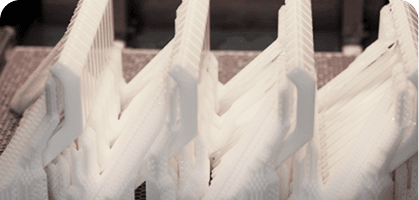
SLS 3D printing main parameters
Parameters
SLS Capabilities
Dimensional Accuracy
±0.3mm or ±0.3%
Minimum Wall Thickness
0.8mm
Maximum Build Size
700 × 380 × 580 mm
Surface Roughness
Ra 10~12 μm
SLS 3D printing
SLS (Selective Laser Sintering) is an industrial powder bed fusion 3D printing technology. It uses a high‑energy laser to selectively sinter thermoplastic powders such as nylon and TPU, building parts layer by layer. During printing, unsintered powder acts as a natural support, eliminating the need for additional support structures. It enables the fabrication of complex geometries including internal cavities, lattices, and integrated hinges. SLS parts feature high density, mechanical properties comparable to injection‑molded components, good heat resistance and dimensional stability. Suitable for functional prototypes, low‑volume end‑use parts and lightweight structures, SLS is widely applied in aerospace, automotive, medical, consumer electronics and other industries。

Available Materials
Explore materials supported by SLS technology, including PA12, PA11, glass-filled nylon, and more.
View Materials
Post-Processing Processes
Explore surface finishing capabilities such as dyeing, sandblasting, and vapor polishing.
View Post-ProcessingSLS 3D printing service compared to other 3D printing technologies
Dimensional accuracy
Strengths
Build volume
Layer thickness
Min.feature size
SLS
+0.3% with a lowerlimit of + 0.3 mm
Design flexibility, support not required
395 x 500 x 395mm
100um
0.762 mm
SLA
Standard: + 0.3% with a lower limit of +0.3 mm Industrial: + 0.2% with a lower limit of +0.13 mm
Smooth surface finish, fine featuredetails
395 x 500 x 395mm
100um
0.762 mm
FDM
Standard: + 0.3% with a lower limit of +0.3 mm Industrial: + 0.2% with a lower limit of +0.13 mm
Smooth surface finish, fine featuredetails
395 x 500 x 395mm
100um
0.762 mm
SLM
Standard: + 0.3% with a lower limit of +0.3 mm Industrial: + 0.2% with a lower limit of +0.13 mm
Smooth surface finish, fine featuredetails
395 x 500 x 395mm
100um
0.762 mm
LCD
Standard: + 0.3% with a lower limit of +0.3 mm Industrial: + 0.2% with a lower limit of +0.13 mm
Smooth surface finish, fine featuredetails
395 x 500 x 395mm
100um
0.762 mm
MJF
Standard: + 0.3% with a lower limit of +0.3 mm Industrial: + 0.2% with a lower limit of +0.13 mm
Smooth surface finish, fine featuredetails
395 x 500 x 395mm
100um
0.762 mm
Get An Instant Quote Online
Upload your 3D model and receive an instant manufacturing quotation.
 Instant Quote